
A Sonic Visualization of Social Transformation (1820–1920)
Sound Art as a Research Method for Historians
Time Prism: A Sonic Visualization of Social Transformation (1820–1920). Five historical groups evolve across a century, rendered through immersive sound and light. This video uses stereo panning to approximate the original five-channel installation.
Scientific research is often driven by a profound sense of wonder — a curiosity about the nature of things and the phenomena behind them. In the context of the natural sciences, this wonder is typically distilled into concrete hypotheses that can be tested in a lab and replicated by other researchers, thus approximating objective knowledge. Within the humanities, knowledge production is a less tangible process, often shaped by the researcher’s prior understanding, theoretical positioning, and academic tradition. In other words, the researcher is a human being who cannot separate themselves from their own humanity — and must therefore acknowledge and embrace it as part of the process.
In a context where the researcher’s own embodied subjectivity is inescapable, affect — understood as a pre-conscious bodily intensity (Massumi, Deleuze, Spinoza) — emerges as a central phenomenon. While resisting full linguistic articulation, affect plays an active role in meaning-making and knowledge production. Artistic practice, when grounded in data and methodological stringency, can serve as both a form of inquiry and a mode of understanding, enabling what may be described as methodical transfer epistemology: the movement of methods across disciplinary boundaries, where affect functions not merely as response, but as a generative force. In this context, artistic research can function as a kind of experimental platform within the humanities — approximating the laboratory conditions of natural science, yet operating in a distinct register where affective intensities become both the foundation and the subject of investigation.
This project investigates whether sound art — methodologically based on historical data — can be used as a research method for historians. It translates a 100-year historical period into a 10-minute musical composition. The full piece consists of five individual audio tracks, each constructed from data carefully selected by a historian, and conveyed through an audiovisual installation. The interaction between these five layers is expected to produce an affectively intelligible materialization of tensions between different social strata in the chosen historical period. The hypothesis is that such an affective-sonic materialization — in combination with visual elements including a timeline — may inspire historians to ask new questions. In this way, art may contribute to a reconfigured historical perspective.
-
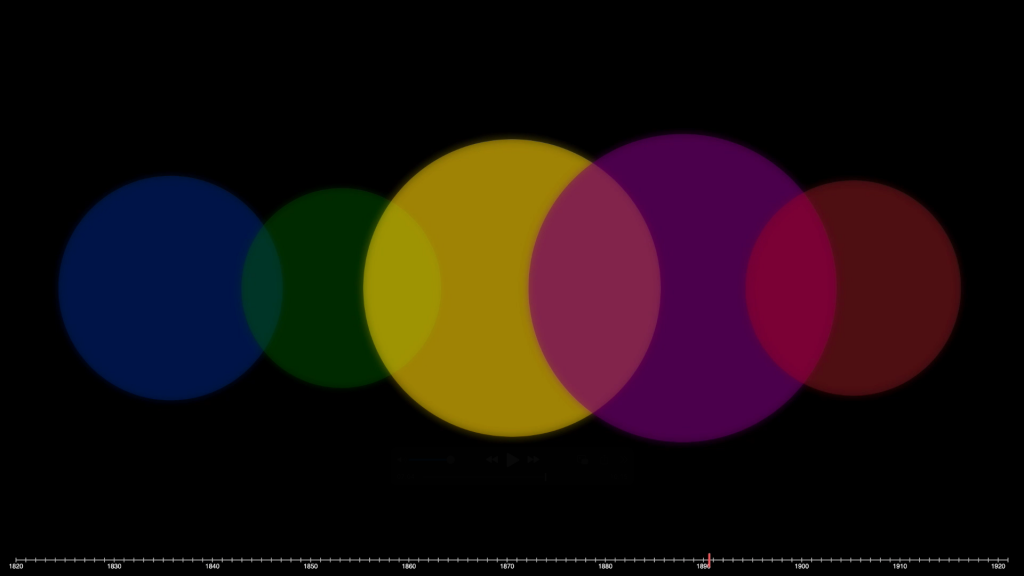
- Each colored circle represents the evolving social presence of a historical group. Sound intensity and visual opacity shift over time, synchronized with a moving historical timeline (1820–1920). Find the full version here.
-
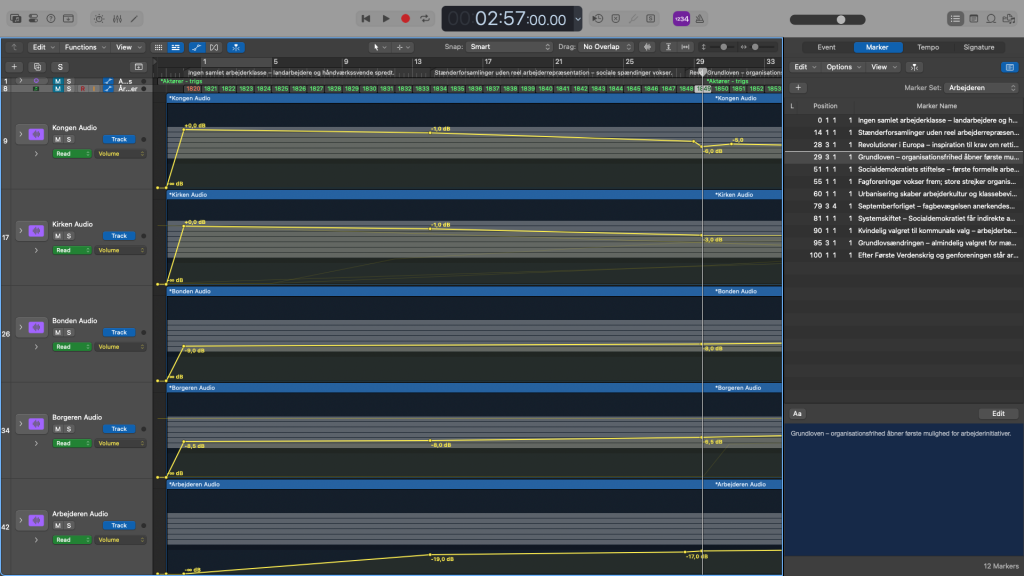
- Production sketch of Time Prism: overview of the five historical soundtracks — king, church, peasant, worker, bourgeoisie — mapped across a century. Timeline annotations reflect key societal shifts (1820–1920).
PROJECT MEMBER(S)
Tao Højgaard
DATE
May 2025