Embodied Musical Mediation Apparatus
EMMA is an interactive sonic interface for embodied and social interaction. Developed as a hexagonal sound sculpture, the project invites multiple participants to engage with sound through bodily movement, spatial proximity, and shared attention. Each side of the sculpture is equipped with a distance sensor that responds to the presence and motion of a participant, shaping musical behavior in real time through an embedded synthesis system. While EMMA can be engaged by a single participant, it is fundamentally designed for multi-participant interaction: as more people enter the system, more voices, zones, and pattern combinations become available, allowing the music to grow denser, richer, and more polyphonic. In this way, EMMA functions not simply as an instrument, but as a shared musical environment in which sound emerges through co-presence, timing, and collective negotiation.
-
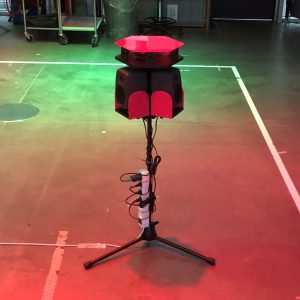
- EMMA in full view. The hexagonal sound sculpture is mounted on a tripod and configured for multi-participant interaction in physical space. Each of the six sides functions as an interactive musical voice, allowing the sonic texture to grow in complexity as more participants engage with the system.
-
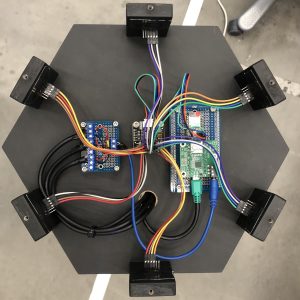
- Top view of EMMA’s sensing and control system. Six distance sensors are distributed around the hexagonal structure and connected to the embedded audio and control electronics at the center, forming the technical basis for EMMA’s distributed six-voice interaction model.
Rather than approaching interaction primarily as control, response, or task completion, EMMA proposes compositional interaction design as a framework in which musical form itself becomes the basis for interaction. The project explores how rhythm, phrasing, harmonic organization, and distributed sonic roles can structure participation between multiple people in real time. Participants do not merely trigger sounds; they move within a composed field of pulse, melodic sequences, overlap, silence, and release, gradually learning how their actions contribute to a larger collective texture. Because each participant can only access part of the total musical structure at any given moment, the full compositional potential of the system only emerges through shared use. In this sense, EMMA is both a platform for collaborative music making and a design exemplar that argues for musical structure as an interactional framework in its own right.
At the musical and technical level, EMMA is structured as a distributed six-voice sequencer instrument. Each side of the hexagonal sculpture operates as an individual voice with its own sequences, timbral profile, and role within a shared rhythmic and harmonic framework, while all voices are synchronized to a common pulse. Movement through spatial zones does not simply modulate a parameter, but activates different pre-composed melodic states, allowing participants to shape density, tension, phrasing, and ensemble interplay through position and timing. After sustained collective presence, a shared beat enters, further supporting entrainment, coordination, and emergent group behavior. Built through Research-through-Design, EMMA also functions methodologically as a sonic probe and epistemic instrument: a concrete artifact through which compositional interaction design is articulated, explored, and empirically examined in practice.
PROJECT MEMBERS
Tao Højgaard
DATE
November 2025 – January 2026