A blog post by Laura Winkler Moreno Twose
Laura Winkler Moreno Twose
I had the privilege of participating in this year’s ACM Summer School on Accessible and
Inclusive Technologies, hosted in Milan, Italy. This year’s edition marked the third time the
summer school has been held. It brought together researchers and students from around the
world to share their perspectives on developing technologies that promote accessibility and
inclusion for people with diverse disabilities.
The summer school featured keynote talks and a hands-on workshop, where we worked
together in interdisciplinary groups, combining our different areas of expertise to address
different cases before presenting our solutions and perspectives to the other participants.
Over the course of the week, we explored a wide range of topics, and in this blog post, I will
highlight some of the things that have stayed with me the most.
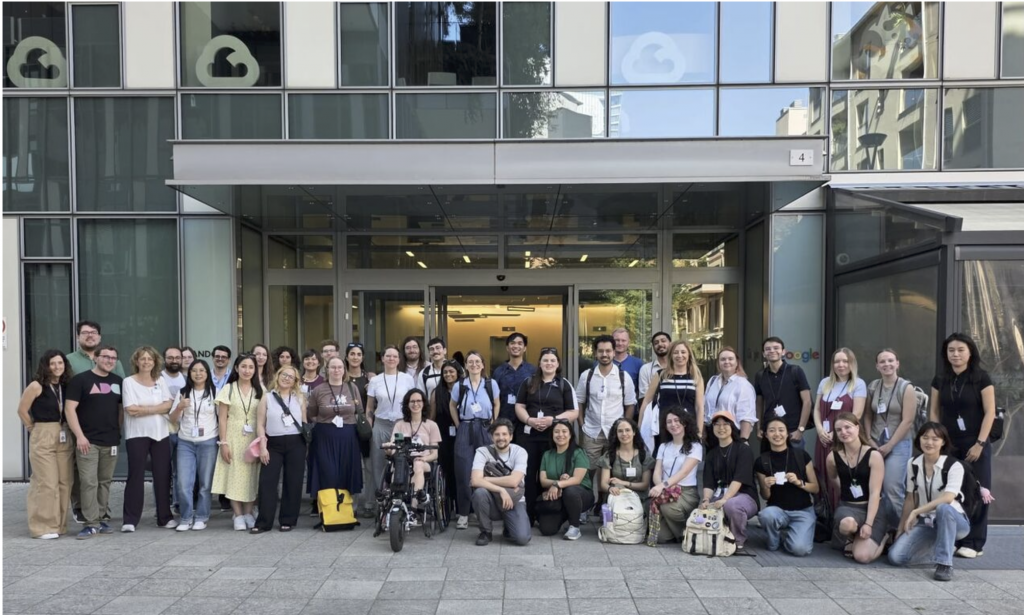
ACM summer school class
Highlights
The first keynote speaker, Stefania Serafin from the Technical University of Denmark,
presented Sonic Universal Design: Designing Sound for Human Diversity. One of the key
messages that stayed with me was that recognizing exclusion is the first step toward creating
truly inclusive technologies.
She also introduced the distinction between permanent, temporary, and situational
disabilities. I found this perspective particularly valuable because it highlights that when we
design solutions for people with permanent disabilities, we often create technologies that
also benefit people experiencing temporary or situational limitations. I think this is an
important perspective to keep in mind when designing technologies for people with
disabilities because it highlights that disability is not a fixed category. We all experience
changes in our abilities throughout life and across different situations. Designing with this in
mind has the potential to create technologies that benefit a much broader range of users.
Another keynote speaker on the first day was Monica Landoni from the Università della
Svizzera italiana, who presented Collaborative Design for Accessibility via Inclusion. During
her talk, she shared findings from a survey of educators at Swiss higher education
institutions in computing and technology disciplines. The study found that 77% did not teach
accessibility because it was not a core part of their courses, while 21% reported that they did
not feel knowledgeable enough to teach it (Guedes & Landoni, 2020). I personally found these
numbers quite shocking and agree with her perspective that accessibility is still too often
treated as something optional—a “nice-to-have” rather than an essential part of the design
process.
During her talk, she used the distinction between equality and equity to illustrate how
fostering equity can increase accessibility in design. After returning home, I came across the
illustration below, originally created by Tony Ruth and featured in an article by the George
Washington University Milken Institute School of Public Health (2020), which I think captures
the distinction particularly well. While equality provides everyone with the same
resources, equity recognizes that people have different needs and may therefore require
different forms of support to achieve comparable opportunities. At the same time, I think the
illustration also reminds us that accessibility should not only focus on providing individual
support but also on identifying structural and societal barriers that lead to exclusion.
In the afternoon on the first day, we visited the Laboratory of Music Informatics (LIM), where
researchers presented a range of projects exploring accessible music technologies. All of the
presentations were inspiring, but one in particular stayed with me. Nicola Davanzo
presented Hands-Free Accessible Digital Musical Instruments for Quadriplegic Musicians,
showcasing instruments that enable people with severe motor impairments to create and
perform music without using their hands.
Davanzo explained that music makes our lives richer and more beautiful, yet many traditional
musical instruments remain inaccessible to people with disabilities. As a result, we are
missing the stories, creativity, and artistic expression that could have been shared through
music. As he explained, “There is a silence not because people do not want to create music,
but because they have not been given the opportunity to do so.” I found this perspective both
moving and a powerful reminder that accessibility is not only about enabling participation but
also about ensuring that voices, experiences, and creativity are not lost in a world that is still
too often designed for the able-bodied.
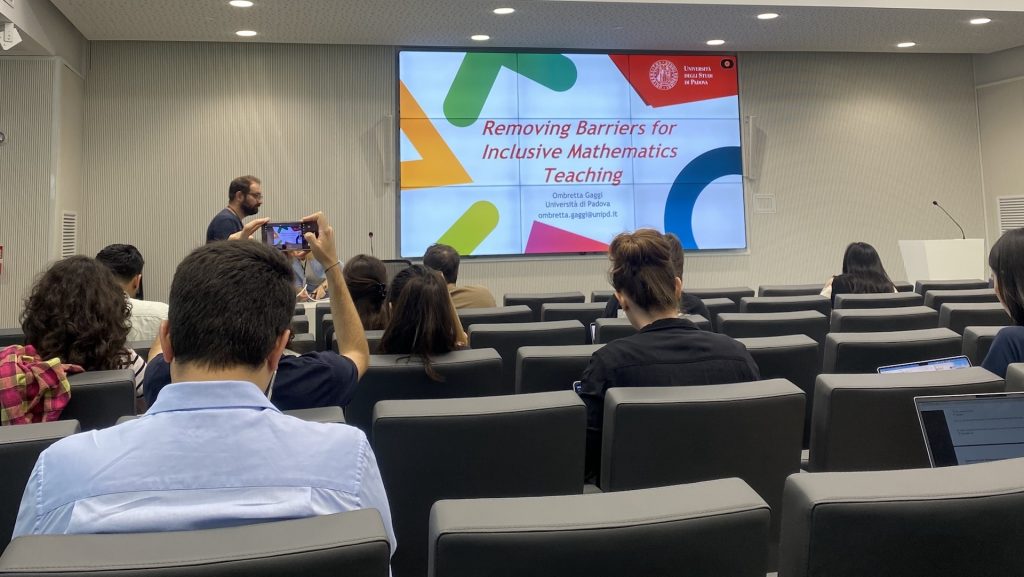
Presentation by Ombretta Gaggi: Removing Barriers for Inclusive Mathematics Teaching
From the second day, I would like to highlight a presentation by Ombretta Gaggi from the
University of Padua entitled Removing Barriers for Inclusive Mathematics Teaching.
Mathematics is a discipline that relies heavily on visual representations such as graphs,
diagrams, and mathematical symbols. Gaggi presented her work on making mathematics
more accessible for people with visual impairments through sonification, in which graphs can
be understood through sound. One example she showed was how the x-axis could be
represented by the frequency of a sound, while the y-axis could be represented by its rhythm
or beats, allowing students to explore graphs through listening rather than vision.
One of the presentations that stood out to me on the third day was Between Independence
and Interdependence, given by Beatrice Vincenzi and Christina Karpodini from Birmingham
City University. Their talk also served as the foundation for a workshop, where we worked in
groups on different accessibility cases. They described how able-bodied people are often
associated with independence, while disabled people are often associated with dependence.
They argued that we should not think of technology as something that eliminates
dependence, but rather as something that redistributes it. They introduced the concept
of interdependence and showed how it can help us rethink both independence and
accessibility. Instead of viewing technology as a tool that makes people completely
independent, they encouraged us to see it as part of a collaborative process, where
technology, people, and the surrounding environment work together to enable participation.
Final thoughts
In addition to the interesting presentations by the keynote speakers, one of my favorite
aspects of the week was how the summer school created a unique space for interdisciplinary
discussions about how technology can be developed not only to address functional needs
but also to support participation, autonomy, and meaningful everyday experiences.
To me, the summer school was a great example of the value of bringing together researchers
from different disciplines and backgrounds. As the field of accessible and inclusive
technologies is still relatively small, it was especially valuable to meet others working on
similar challenges and to exchange ideas and feedback. Many of the conversations that took
place outside the scheduled sessions were just as inspiring as the lectures themselves, and I
left Milan with new perspectives, new connections, and plenty of inspiration for my own
research.
Reference
Illustration of the distinction between equality and equity. Original illustration by Tony Ruth
(Addressing Imbalance, Design in Tech Report 2019). Reproduced from George Washington
University Milken Institute School of Public Health (2020).
Guedes, L. S., & Landoni, M. (2020). How are we teaching and dealing with accessibility? A
survey from Switzerland. In Proceedings of the 9th International Conference on Software
Development and Technologies for Enhancing Accessibility and Fighting Info-exclusion (DSAI
2020), 141–146. https://doi.org/10.1145/3439231.3440610